Showing posts with label digital amnesia. Show all posts

Monday, October 10, 2016

Digital Amnesia In Practice (mobile phone use)

       From the unlimited access to information on the internet, to the smartphones that we carry all of our information on, technology is changing the way our brains store information. With infinite information only a few clicks away, it tends to be very natural for us to rely on digital devices to store the info we otherwise would have to remember. This is called 'the google effect', or 'digital amnesia'.

       Digital Amnesia In Practice

       The Kaspersky Lab shows us that most phone customers in the United Kingdom can't remember important phone numbers from memory including; those of their children, their children's schools, their place of work, their partner. However, half of these interviewed people could easily recall their home phone number from when they were younger. This directly shows how nowadays people don't bother to store certain crucial information, simply because they know it is available to them through their everyday mobile device.
       Researchers say that as we store more information on mobile phones, our brain is actually encouraged to forget the information it formerly stored. This is due to our limited brain capacity.

       Modern Day Reliance

       Kaspersky's lab shows that over half of the younger people surveyed, admitted that their phone holds pretty much all of what they need to know. Clearly, this shows how crucial smartphones and that other technology has become in regards to the information we rely on day to day. This study shows that the loss of a person's smartphone can not only be inconvenient, but devastating. Almost half (44%) of women surveyed, said they would be overwhelmed and saddened if they lost their smartphone due to the fact that they believed they would lose memories they could never get back. Also, a quarter of the women surveyed (and 38% of the younger people surveyed) said they would be 'completely frantic' since their smartphone is their primary source of data, images and contact information. Years ago these images would be tangible, and the contact information would be mostly stored in your brain and written down somewhere as a backup, not as a primary source of the info.

References:
http://www.cbc.ca/news/technology/digital-amnesia-kaspersky-1.3262600 , https://blog.kaspersky.com/digital-amnesia-survival/9194


To Look Up or Learn With Easy & Hard Questions

Often when we look to search things on the internet it’s usually something we don’t have the direct specific answer to. This is because what were usually intrigued to answer doesn’t fall into the simple or easy question category. When we don’t know something and refer to looking it up later on the internet, it’s usually unique and of great difficulty compared to our knowledge at the current moment. Because of this, we can infer that the Google effect concludes of difficult things we are sure to be unaware of and isn’t something we should already know. Therefore it’s usually something were most likely to look up so that we can learn it. When we are asked difficult questions we do not know the answer to we tend to turn to the internet and when questions aren’t too difficult we answer them directly. Although we may look up specific facts we may end up forgetting them because they might not have important value in meaning or they might not be worth remembering just because we had to look it up. For example, if you ask the average person “How many points did Lebron James average in his 2015-2016 NBA season?” The average person wouldn’t know that question as it would fall into the hard question category as specific as it is. This person might need to reference this question later on but is it really something that they have to know? The importance of the specific question really matters.

This brings up another topic as to are these questions, questions we have to learn or look up that determine the importance of what was being asked. In most cases when the Google effect occurs is when people say they will “look up” the information later. “To "Look up" means making a conscious decision to want or need to seek more information about a topic later; to remember where you may find information later, but not to memorize it now. For example, you decide not to memorize math formulas because you will be given a formula sheet during the test. “Learn” means being able to reproduce the information from memory.” GENERATION AND THE GOOGLE EFFECT.... - Jessica Siller Page 36. Analyzing what is said, It’s important to properly categorize what is being asked to determine how we go about these questions. The example of the Lebron question asked fell into the to “look up” category as we did not need to memorize what was being asked. We could also imply that age is a factor as those who are more likely to learn information are typically younger people such as students who are in school compared to older people who are not necessarily learning as much in their current stage of life. Therefore they would be more likely to look up and less likely to learn information.


In Appendix A of the link below people were surveyed on “Easy Question Block” where a simple “Yes or No” question was asked on basic knowledge. These questions were found to be quite answerable and less complicated and challenging. In Appendix B  was a survey on “Hard Question Block” and the results were that only 51% of the hard questions were answered correctly compared to a 90% correct rate for the easy block questions. Not knowing the answer to the hard questions primed the need to search for it in most cases as prior information and knowledge were not there. The Implications that set it all was the 3rd part Appendix C which was a “Look up or Learn” survey and results showed that there was a strong tendency for people to learn rather than look up which goes against the Google effect in results to show that instead of forgetting to look up what we intentionally were to look up, we actually look it up to learn it. Appendix A:31 Appendix B:33 Appendix C:35/Siler_Jessica_B_201308_BS.pdf


Saturday, October 8, 2016

Connectivity & Reliance

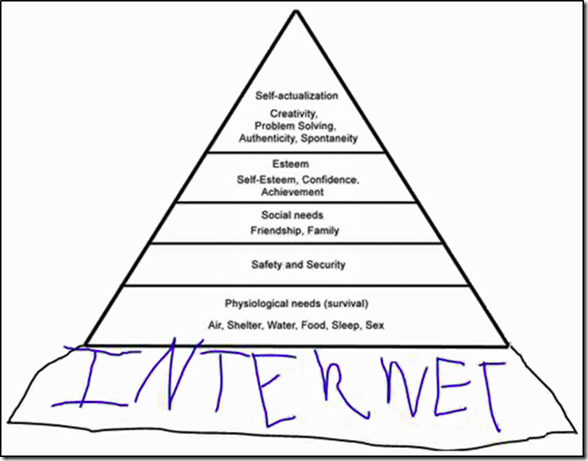
Through years of development in human progress and technology our understanding of the world and the way we communicate has never been any better. The more and more connections we make today, the more and more opportunities we will have tomorrow. The underlying importance of connectivity is that because of it, we evolve at a faster rate discovering new things and assessing new challenges only for the better. Our reliance on technology expands as we develop technologies itself shifting towards more complex things. Our physiological needs shift because of technology. Our initial needs become fulfilled and satisfied as we no longer need to depend on the essentials of life such as water, food, and health. We don’t live in a day in age anymore where not too long ago our main concern was about cooking food and being limited to how little we can do in a day. Or the fact that we have to do things with time and effort such as going to the library, looking for a book, checking it out, and finally reading it. In relation to the google effect, if you go by it, you are more than likely to be utilizing the reliance of google and what it has to offer. Always trusting the internet to find new information may not necessarily be a bad thing as it encourages us to learn, connect and develop. There are those who say they would look something up later on google and might and up forgetting but to those who actually do learn something from it.


“Through the reliance of the Internet we can fulfill all our physiological needs, therefore our reliance on the internet is making us much more aware and smarter of our individual self and what’s around us”


According to research findings from the Digital Amnesia Report (1). “The results reveal that the “Google Effect” likely extends beyond online facts to include important personal information.” Through these findings an increasing amount of people ranging from young consumers to adults had connected devices as their primary source of knowledge as well as default space for storage information. The study showed that the 16-44 year olds surveyed categorized two main broad categories which were recalling knowledge and insight, and the recall of personal information. A trust and reliance on these two categories can benefit an individual with the ability to link connections, understand and learn more about themselves. Retrieved from Digital Amnesia Report (Page 4) Kaspersky Lab.

One thing we take for granted and hardly realize is our reliance on technology. Every day we begin to trust technology more and more. We realize the benefits of such things and utilize it to the best of our ability. As our reliance grows on technology so does the development of human progress. We begin to work more efficiently, smarter, and with ease. One could argue that there are so many disadvantages to the reliance of technology but what underlies is the fact is that it’s the little things such as the google search engine that change our lives inch by inch.


References: